Quick Answer: You can build five different salmon rice bowls for the week in about 15 minutes each by using pre-cooked rice, quick-searing or air-frying salmon portions, and rotating simple sauces and toppings. Each bowl delivers roughly 30 to 40 grams of protein and stays fresh in the fridge for up to 4 days. These are not complicated recipes. They are repeatable systems you build once and eat all week.
Tested in Maya’s kitchen, July 2026.
Key Takeaways
- All 5 salmon rice bowl meal prep ideas in this guide come together in 15 minutes or less per session when you use pre-cooked or microwavable rice.
- Salmon is one of the most efficient high-protein meal prep proteins, cooking fully in 6 to 10 minutes on a skillet or in an air fryer.
- A 6-oz salmon fillet delivers 34g of protein and significant omega-3 fatty acids per serving (USDA FoodData Central).
- Each bowl stores well in an airtight container for 3 to 4 days in the refrigerator (USDA food safety guideline for cooked fish).
- Rotating sauces (teriyaki, gochujang, miso, poke marinade) is the fastest way to keep five bowls tasting different without extra cook time.
- Glass containers with locking lids are the best choice for reheating salmon bowls without odor transfer.
- Prep your toppings in bulk once at the start of the week to cut assembly time to under 5 minutes per bowl.
- Salmon rice bowls work equally well with jasmine rice, brown rice, or cauliflower rice for lower-carb versions.
What Makes Salmon Rice Bowls a Smart Meal Prep Choice?
Salmon rice bowls hit a practical sweet spot: high protein, fast to cook, and genuinely enjoyable to eat cold or reheated. A 6-ounce salmon fillet provides roughly 34 grams of protein and significant omega-3 fatty acids, making it one of the more nutritionally complete proteins you can add to a weekly meal prep rotation.
The rice base is flexible. Jasmine rice, brown rice, sushi rice, and cauliflower rice all work. If you cook a large batch of rice at the start of the week or use microwavable pouches, you remove the biggest time barrier entirely.
Why salmon specifically?
- Cooks in 6 to 10 minutes on medium-high heat, faster than chicken thighs or beef
- Holds up well in the fridge without drying out, especially when stored with sauce
- Pairs with a wide range of flavor profiles (Asian, Mediterranean, Hawaiian, Korean)
- Available as fresh fillets, frozen portions, or canned for budget-friendly versions
If you want to expand your protein rotation beyond salmon, check out these high-protein lunch meal prep ideas for more variety throughout the week.
How to Prep Salmon in Under 15 Minutes (The Core Method)
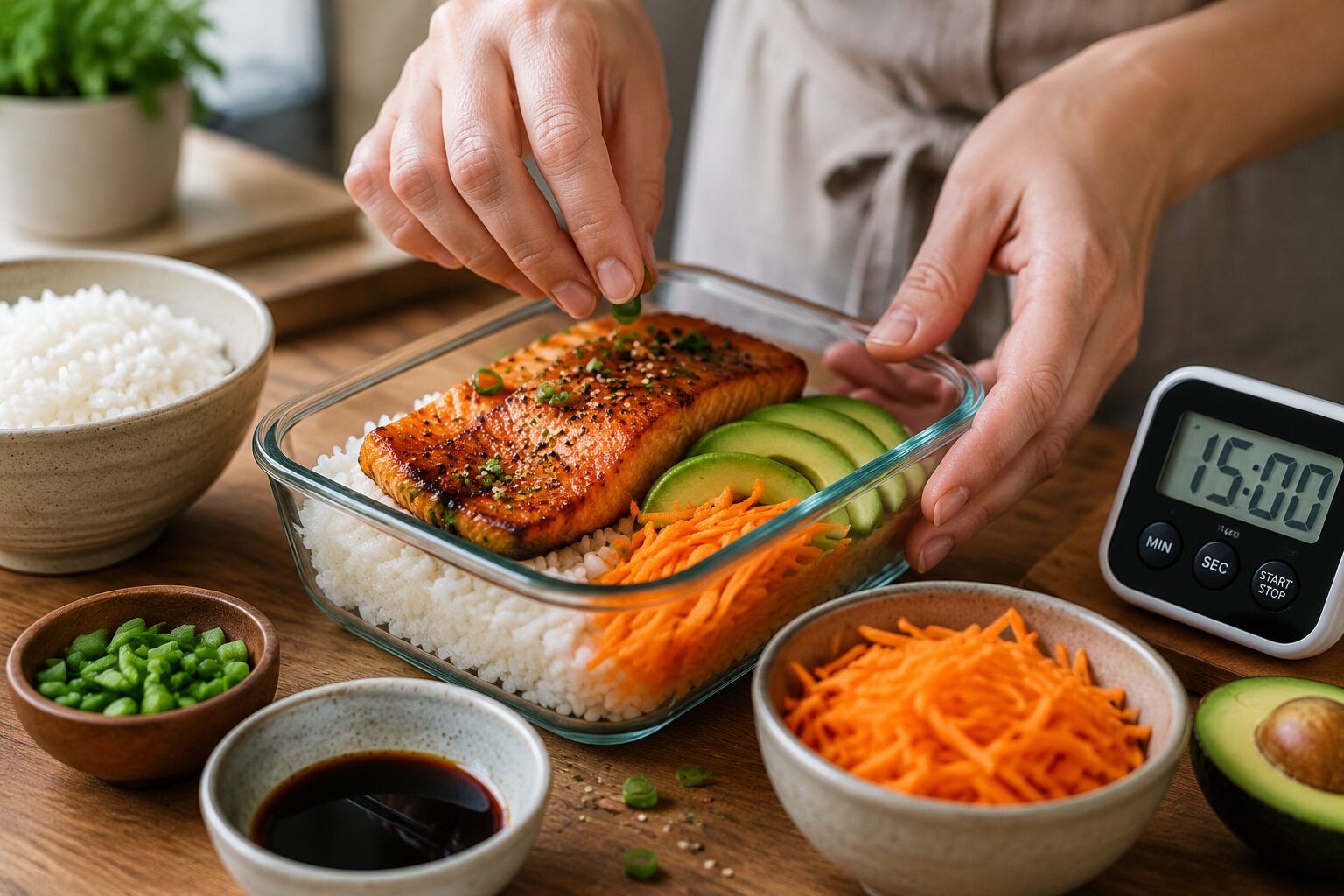
The 15-minute target is realistic only if you follow a specific prep order. Here is the method used every week.
- Start your rice first (or use pre-cooked). Microwavable pouches take 90 seconds.
- Pat salmon dry and season while the pan heats to medium-high. This takes about 1 minute.
- Cook salmon skin-side down for 4 minutes, flip, cook another 3 to 4 minutes. Internal temp should reach 145°F (USDA recommendation for cooked fish).
- Prep toppings while salmon cooks: slice cucumbers, scoop edamame, halve cherry tomatoes.
- Assemble bowls: rice base, salmon portion, toppings, sauce drizzled on top.
- Seal and refrigerate within 2 hours of cooking.
Total active time: 12 to 15 minutes per bowl session, or about 30 to 40 minutes if you are prepping all 5 bowls at once using one large batch cook.
Common mistake: Adding avocado before storing. Always add fresh avocado at serving time. It browns and turns mushy within 24 hours in a sealed container.
For air fryer fans, the air fryer salmon meal prep method produces consistently flaky results at 400°F for 8 to 10 minutes.
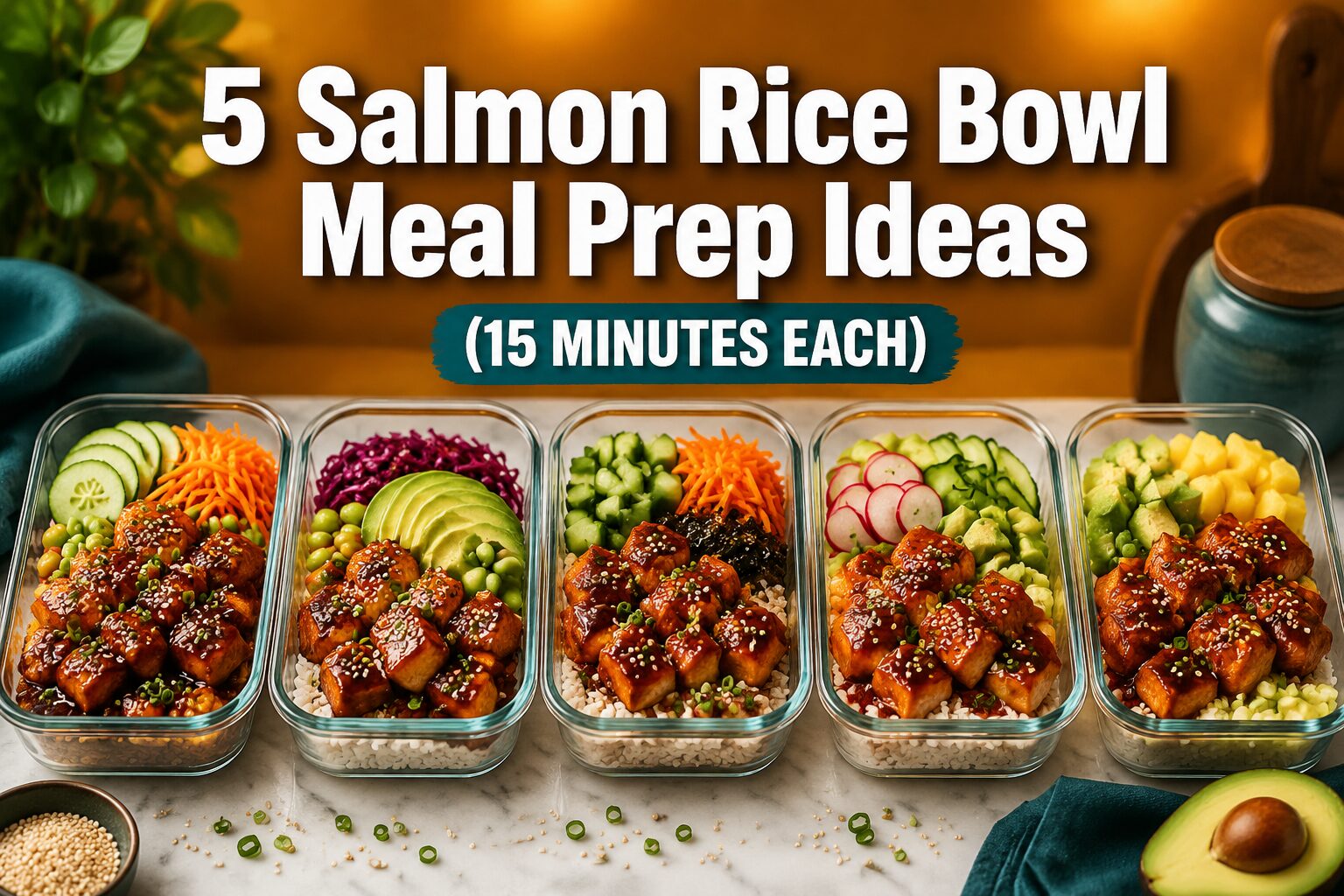
The 5 Salmon Rice Bowl Meal Prep Ideas (15 Minutes Each)
These are the 5 bowls to rotate through most often. Each one uses a different sauce and topping set so the week never feels repetitive. All five follow the same core cooking method above.
Bowl 1: Teriyaki Salmon Rice Bowl
~34g protein | ~490 calories | ~$5.80/serving
Sauce: 2 tbsp (30g) store-bought or homemade teriyaki (soy sauce, honey, garlic, ginger)
Toppings: Steamed broccoli 75g (~3/4 cup), shredded carrots 30g (1/4 cup), sesame seeds 3g (1 tsp), green onions 10g (2 tbsp)
Rice base: Jasmine rice, 1 cup cooked (185g)
Brush 2 tablespoons of teriyaki sauce onto the salmon during the last 2 minutes of cooking. The sugars in the sauce caramelize quickly, so watch the heat. This is the most beginner-friendly bowl of the five.
The #1 failure mode for this bowl: Teriyaki sauce burns at high heat. The sugars in teriyaki go from caramelized to scorched in under 30 seconds on a hot pan. Add sauce only in the last 90 seconds of cooking, drop to medium heat, and watch constantly.
For a deeper dive into this specific bowl, the teriyaki salmon bowl meal prep guide covers sauce ratios and storage tips in full detail.
Bowl 2: Salmon Poke Bowl
~36g protein | ~480 calories | ~$6.00/serving
Sauce: Soy sauce 2 tbsp (30g), sesame oil 1 tsp (5g), rice vinegar 1 tsp (5g), sriracha 1/2 tsp (3g)
Toppings: Cucumber 75g (1/2 cup), edamame 40g (1/4 cup), shredded purple cabbage 20g (1/4 cup), pickled ginger 20g (1 tbsp), sesame seeds 3g (1 tsp)
Rice base: Sushi rice, 1 cup cooked (200g)
For meal prep, use seared salmon rather than raw. Raw fish does not hold safely in the fridge for more than 1 day. Cube the cooked salmon and toss it in the poke sauce before assembling. The salmon poke bowl meal prep guide has the exact sauce proportions if you want to make it from scratch.
The #1 failure mode for this bowl: Using raw salmon past the 24-hour mark. Raw fish in meal prep is safe only for Day 1. By Day 2, bacterial growth risk increases significantly. Always use seared salmon for any bowl eaten on Day 2 or beyond.
Bowl 3: Korean Gochujang Salmon Bowl
~34g protein | ~500 calories | ~$5.90/serving
Sauce: Gochujang paste 1 tbsp (18g), soy sauce 1 tsp (5g), sesame oil 1 tsp (5g), honey 1 tsp (7g)
Toppings: Kimchi 60g (1/4 cup), cucumber ribbons 60g (1/2 cup), sesame seeds 3g (1 tsp), sliced green onions 10g (2 tbsp)
Rice base: Short-grain white rice, 1 cup cooked (200g)
This bowl has the most flavor complexity of the five. The gochujang sauce is spicy and slightly sweet. If you are new to Korean-inspired bowls, start with half a tablespoon of gochujang and increase from there.
The #1 failure mode for this bowl: Too much gochujang. One tablespoon per serving is the ceiling. Heat compounds as the sauce sits in the fridge overnight, and the bowl becomes one-dimensional: all heat, no salmon flavor. Start at 1/2 tablespoon if you are new to gochujang.
Bowl 4: Mediterranean Herb Salmon Bowl
~35g protein | ~510 calories | ~$5.70/serving
Sauce: Lemon juice 2 tbsp (30g), olive oil 1 tbsp (14g), garlic 1 clove (3g), dried oregano 1/2 tsp (1g)
Toppings: Cherry tomatoes 75g (1/2 cup, halved and drained), cucumber 50g (1/3 cup), kalamata olives 30g (~8 olives), crumbled feta 20g (2 tbsp), red onion 20g (2 tbsp)
Rice base: Brown rice, 1 cup cooked (195g)
Season the salmon with 1 teaspoon of dried oregano and a pinch of smoked paprika before cooking. This bowl works especially well cold, making it a good option for packed lunches with no reheating required.
The #1 failure mode for this bowl: Whole cherry tomatoes sitting on the rice. Whole tomatoes release juice that soaks into the rice, making it mushy by Day 2. Always halve and blot dry with a paper towel before adding, or store tomatoes separately.
Bowl 5: Miso Ginger Salmon Bowl
~34g protein | ~480 calories | ~$5.80/serving
Sauce: White miso paste 1 tbsp (17g), rice vinegar 1 tsp (5g), sesame oil 1 tsp (5g), fresh grated ginger 1 tsp (3g)
Toppings: Shelled edamame 40g (1/4 cup), shredded carrots 30g (1/4 cup), sliced radish 20g (4 to 5 slices), sesame seeds 3g (1 tsp)
Rice base: Brown rice or cauliflower rice, 1 cup cooked (195g or 100g)
Whisk 1 tablespoon of white miso with 1 teaspoon of rice vinegar and 1 teaspoon of sesame oil. Spoon over the salmon after plating. Miso is salty on its own, so taste before adding any extra salt.
The #1 failure mode for this bowl: Using more than 1 tablespoon of miso paste. White miso contains approximately 630mg of sodium per tablespoon. Combined with salmon’s natural sodium and sesame oil, one tablespoon already pushes the bowl toward 800mg of sodium total. Going to 2 tablespoons can reach 1,200mg in this bowl alone.
Full Macro Breakdown: All 5 Bowls
Each number below is based on a 6-ounce salmon portion with 1 cup of cooked rice and standard toppings. Fat is higher in the Mediterranean Herb bowl because feta and kalamata olives add 40 to 60 extra calories. The Poke bowl edges ahead on protein because edamame contributes an extra 2g per quarter-cup serving. Figures use USDA FoodData Central values. Omega-3 (EPA+DHA) values are based on farmed Atlantic salmon (approximately 2,200 to 2,600mg per 6oz cooked portion); figures represent the midpoint of that range.
| Bowl | Protein | Calories | Carbs | Fat | Omega-3 (EPA+DHA) | Cost/Serving |
|---|---|---|---|---|---|---|
| Teriyaki Salmon | ~34g | ~490 | ~50g | ~20g | ~2,500mg | ~$5.80 |
| Salmon Poke Bowl | ~36g | ~480 | ~48g | ~19g | ~2,500mg | ~$6.00 |
| Korean Gochujang | ~34g | ~500 | ~52g | ~20g | ~2,500mg | ~$5.90 |
| Mediterranean Herb | ~35g | ~510 | ~48g | ~23g | ~2,500mg | ~$5.70 |
| Miso Ginger | ~34g | ~480 | ~48g | ~20g | ~2,500mg | ~$5.80 |
The American Heart Association recommends at least 1,000mg of combined EPA+DHA per day for general heart health. Each bowl, based on a 6-ounce farmed Atlantic salmon portion, delivers roughly 2,500mg of EPA+DHA — 2.5 times that daily target in one meal. If omega-3 content is a priority, Costco frozen wild-caught sockeye salmon delivers 2,600 to 3,000mg EPA+DHA per 6 ounces, compared to farmed Atlantic’s 2,200 to 2,600mg, making it a worthwhile swap at a comparable price point.
What These 5 Bowls Cost vs. a Poke Restaurant
Fresh salmon is the most expensive protein in this rotation. A 2-lb salmon fillet at mid-2026 prices runs about $16 to $20 at Whole Foods or Costco. That covers all 5 bowls. Add rice, sauces, and toppings and the total comes to roughly $29 to $33 for 5 servings, or $5.80 to $6.60 per bowl.
| Bowl | Home Cost/Serving | Protein (g) | Protein/$ | Poke Restaurant Price | Weekly Savings (5 bowls) |
|---|---|---|---|---|---|
| Teriyaki Salmon | $5.80 | 34g | 5.9g | $18-22 | $61-81 |
| Salmon Poke Bowl | $6.00 | 36g | 6.0g | $18-24 | $60-90 |
| Korean Gochujang | $5.90 | 34g | 5.8g | $17-22 | $56-81 |
| Mediterranean Herb | $5.70 | 35g | 6.1g | $16-20 | $52-73 |
| Miso Ginger | $5.80 | 34g | 5.9g | $17-22 | $57-81 |
Using Costco frozen salmon ($7.99/lb in June 2026) instead of fresh fillets drops the cost per bowl to about $4.20 to $4.60, pushing protein per dollar up to 7.4 to 8.1g/$. Frozen salmon thawed overnight in the fridge performs identically in all five bowl recipes.
Fresh, Frozen, or Canned: Which Salmon to Buy
The salmon type you choose changes the cost, prep time, and texture of these bowls. Here is how the three options compare for meal prep specifically.
| Factor | Fresh Fillet | Frozen Fillet (Costco) | Canned Wild-Caught |
|---|---|---|---|
| Cost per 6oz serving | $4.50 to $6.00 | $2.40 to $2.80 | ~$2.50 |
| Protein per serving | ~34g | ~34g | ~28 to 32g |
| Cook time | 15 min active | 15 min active (after overnight thaw) | 0 min (ready to use) |
| Texture after storing | Firm, flaky | Firm, flaky | Softer, slightly crumbly |
| Flavor | Richest, most pronounced | Nearly identical to fresh | Milder, slightly briny |
| Best for which bowls | All 5 | All 5 | Poke, Mediterranean (cold only) |
Frozen wins on cost without sacrificing much. Thaw in the fridge overnight and pat dry before cooking. Canned is the fastest option and works well in the cold bowls (poke and Mediterranean) where texture differences matter less. Avoid canned salmon in the teriyaki or gochujang bowls, as the softer texture does not hold up to high-heat sauce glazing.
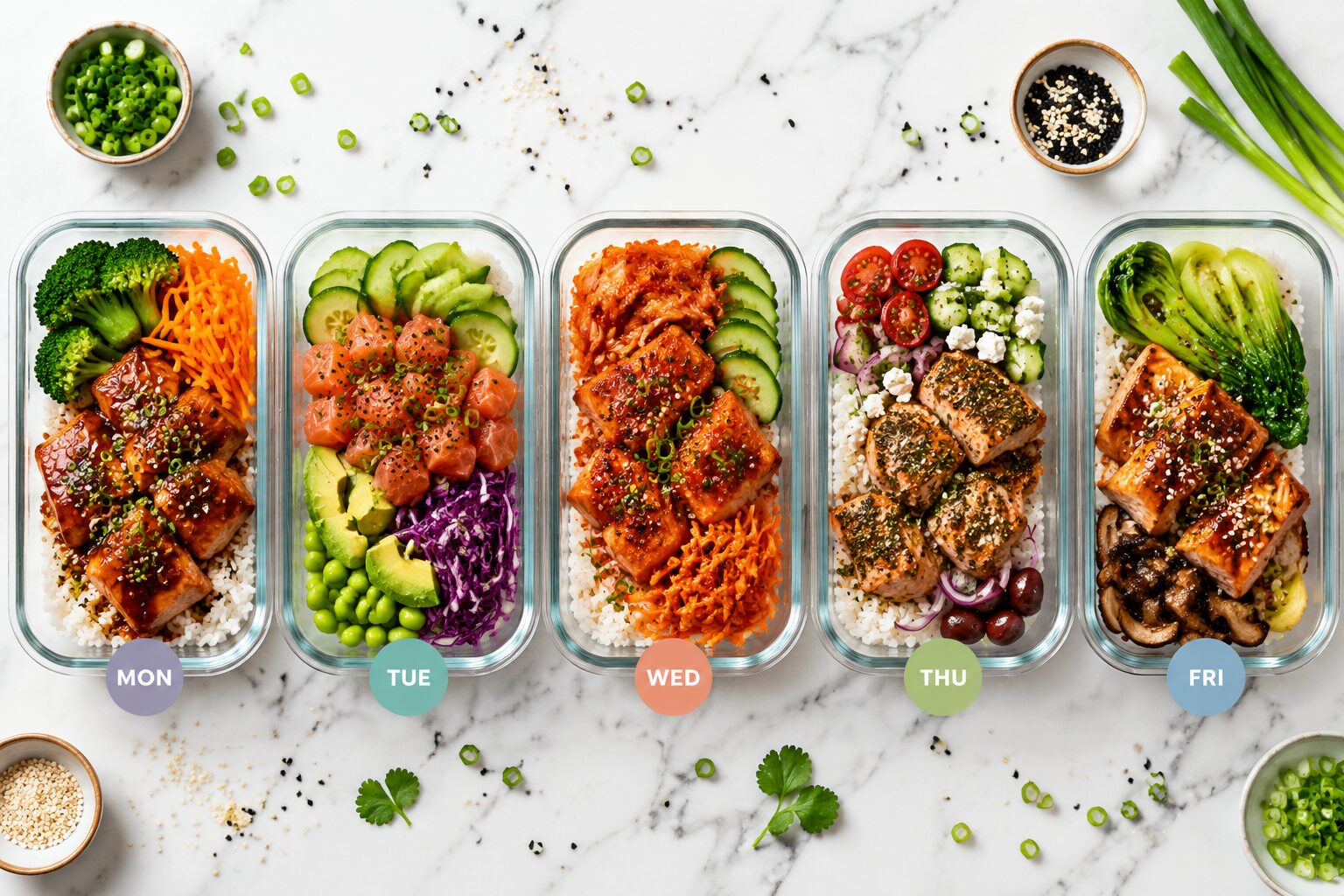
Which Bowl for Which Day
Not all five bowls age the same way. Eating them in the right order keeps every lunch at peak quality and avoids the quality drop-off that makes people give up on salmon meal prep.
| Day | Bowl to Eat | Reason |
|---|---|---|
| Monday (Day 1) | Salmon Poke Bowl | Cubed salmon loses texture fastest; eat it while it’s most tender and fresh |
| Tuesday (Day 2) | Teriyaki Salmon Bowl | Teriyaki sauce absorbs into fish overnight; flavor peaks on day 2 |
| Wednesday (Day 3) | Korean Gochujang Bowl | Gochujang and kimchi both deepen in flavor over 2 to 3 days in the fridge |
| Thursday (Day 4) | Mediterranean Herb Bowl | Olive oil and lemon preserve moisture; works great cold, no reheating needed |
| Friday (Day 4) | Miso Ginger Bowl | Miso-glazed salmon holds well; eat the same day or next for safety |
This sequence means you are always eating the most time-sensitive bowl first. If you prep on Sunday, the poke bowl goes in on Monday at the latest. By the time you reach Thursday and Friday, the Mediterranean and miso bowls are well within safe storage range and still excellent quality.
How to Store and Reheat Salmon Rice Bowls Safely
Proper storage is what separates a good meal prep system from one that leads to wasted food or food safety issues.
| Factor | Guideline |
|---|---|
| Refrigerator shelf life | 3 to 4 days (USDA guideline for cooked fish) |
| Freezer shelf life | Up to 3 months (texture changes after thawing) |
| Container type | Airtight glass or BPA-free plastic with locking lid |
| Sauce storage | Store separately if possible to prevent soggy rice |
| Avocado/fresh herbs | Add at serving time only |
Storage quality day by day:
Day 1 (cook day or next morning): Peak quality across all five bowls. Salmon is moist and flaky, sauce is bright, rice has ideal texture. Eat the poke bowl on day 1 if possible, since cubed salmon dries faster than whole fillets.
Day 2 to 3: Still very good. The teriyaki and miso bowls actually improve slightly as the sauce absorbs into the fish overnight. Mediterranean bowl holds best cold. Brown rice develops a firmer, chewier texture. Jasmine rice stays softer.
Day 4: Safe per USDA guidelines for cooked fish but quality drops. Salmon may be slightly drier and the smell becomes stronger when reheated. Add a drizzle of olive oil or soy sauce before reheating to restore moisture. Discard immediately if there is any sour smell or slimy texture.
Reheating options:
- Microwave: 1.5 to 2 minutes on medium power with a damp paper towel over the container. This prevents the salmon from drying out.
- Skillet: 2 to 3 minutes on medium heat with a splash of water. Good for crisping the salmon back up slightly.
- Cold: The Mediterranean and poke bowls taste great straight from the fridge. No reheating needed.
Edge case: If your salmon smells sour or the texture is slimy after 3 days, discard it. Do not rely on appearance alone. When in doubt, throw it out.
What Doesn’t Work With Salmon Meal Prep (and Why)
Raw salmon in meal prep bowls. Raw poke-style salmon is only safe for 1 day maximum in the fridge. For a 4-day prep rotation, always use seared or baked salmon. The texture difference is minimal when the fish is well-seasoned and the sauce is good.
Very thin salmon portions (under 3/4 inch thick). Thin fillets overcook easily during searing and become dry by day 2. Buy salmon portions that are at least 1 inch thick at the thickest point. If you can only find thin fillets, reduce cook time to 2 to 3 minutes per side and pull at 140°F (it will continue cooking slightly as it cools).
Full-power microwave reheating. At 100% microwave power, salmon goes from moist to rubbery in under 90 seconds. Always use 50 to 60% power for 1.5 to 2 minutes. This one mistake is why people think reheated salmon tastes bad. The fish is fine. The reheating method is the problem.
Mixing avocado or soft herbs into the container before refrigerating. Avocado browns within 4 to 6 hours. Fresh basil turns black. Pack these separately and add at serving time only.
What Rice Works Best for Salmon Bowl Meal Prep?
| Rice Type | Texture After Reheating | Protein per Cup (cooked) | Best For |
|---|---|---|---|
| Jasmine rice | Soft, slightly sticky | ~4g | Teriyaki and poke bowls |
| Brown rice | Firm, chewy | ~5g | Mediterranean and miso bowls |
| Sushi rice | Sticky, dense | ~4g | Poke bowls |
| Cauliflower rice | Soft, light | ~2g | Low-carb versions |
Pre-cook a large batch of rice on Sunday and portion 1 cup per bowl. This single step cuts your daily prep time to under 5 minutes for the rest of the week.
Can You Meal Prep All 5 Salmon Rice Bowl Ideas in One Session?
Yes, and this is actually the most efficient approach. Here is how to do it in one batch cook session of about 45 to 60 minutes total.
- Cook rice in bulk: One large pot or rice cooker batch covers all 5 bowls. Divide into 5 containers while warm.
- Cook all salmon at once: Use two skillets or cook in two batches. Season each fillet differently before cooking.
- Prep toppings assembly-line style: Slice all cucumbers, portion edamame, shred carrots, and prep other toppings across a cutting board in one pass.
- Sauce each bowl: Keep sauces in small squeeze bottles or ramekins for easy portioning.
- Seal and label with the day of the week, following the “which bowl for which day” sequence above.
FAQ: Salmon Rice Bowl Meal Prep
Q: Can I use frozen salmon for these bowls?
Yes. Thaw overnight in the fridge or under cold running water for 20 to 30 minutes. Pat completely dry before cooking or the salmon will steam instead of sear.
Q: How do I keep the rice from getting hard in the fridge?
Store rice in an airtight container and add a very small splash of water before reheating. Jasmine rice holds its texture better than brown rice after 2 to 3 days.
Q: Can I freeze salmon rice bowls?
You can freeze the salmon and rice separately for up to 3 months. Fully assembled bowls with fresh toppings do not freeze well. Cucumbers and leafy greens become watery after thawing.
Q: How much salmon do I need for 5 bowls?
Plan on 6 ounces of raw salmon per bowl. For 5 bowls, that is about 1.9 pounds of salmon total. Buy a 2-pound fillet and you will have a little extra.
Q: Is canned salmon a good shortcut?
Yes. Canned salmon works well for cold bowls like the poke or Mediterranean versions. It is already cooked, so assembly takes under 5 minutes. Look for wild-caught varieties with no added salt. At about $2.50 per can, it cuts the cost per serving to roughly $3.00 and pushes protein per dollar up to 11.3g/$.
Q: Can I substitute another fish?
Tuna, trout, and cod all work with these flavor profiles. For a tuna-based poke bowl, the poke bowl meal prep with tuna guide is a direct alternative.
Q: What containers are best for salmon meal prep?
Glass containers with locking lids are best because they do not absorb fish odor the way plastic does. For specific picks, see the best meal prep containers guide.
Q: How do I prevent the salmon from sticking to the pan?
Use a well-heated pan with a thin layer of oil. Place the salmon skin-side down first and do not move it for the first 3 to 4 minutes. It will release naturally when it is ready to flip.
Q: Are these bowls good for muscle gain?
Each bowl with a 6-ounce salmon portion and 1 cup of rice provides roughly 34 to 36 grams of protein and 50 to 60 grams of carbohydrates, which fits well into a muscle-building meal plan.
Q: Can I make these bowls gluten-free?
Yes. Swap regular soy sauce for tamari or coconut aminos in the teriyaki, poke, Korean, and miso sauces. Check that your miso paste is also labeled gluten-free, as some brands include barley.
Start With One Bowl This Week
Start with one bowl. Pick the flavor profile that sounds most appealing, whether that is the familiar teriyaki or the bolder Korean gochujang, and build it once. Once you have done it once, the second bowl takes half the mental effort. By the third week, you will have a reliable rotation that covers your lunches or dinners without any daily cooking.
- Pick one of the 5 bowls above and buy the ingredients this week.
- Cook a batch of rice on Sunday and portion it into 5 containers.
- Cook your salmon using the 15-minute core method above.
- Label containers with the day of the week using the eating-order table above.
- Add fresh toppings like avocado or herbs at serving time.
Related Reading:
- Teriyaki Salmon Bowl Meal Prep
- Salmon Poke Bowl Meal Prep
- Air Fryer Salmon Meal Prep
- High-Protein Meal Prep for Beginners
- Best Glass Meal Prep Containers
References
- U.S. Department of Agriculture Food Safety and Inspection Service. Safe Minimum Internal Temperature Chart. USDA FSIS, 2024.
- U.S. Department of Agriculture FoodData Central. Salmon, Atlantic, farmed, cooked, dry heat. USDA, 2019. https://fdc.nal.usda.gov/
- U.S. Department of Agriculture Food Safety and Inspection Service. Refrigeration and Food Safety. USDA FSIS, 2013.
Written by Maya Carter, meal prep writer and home cook at BeefSteakVeg. Tested in Maya’s kitchen, July 2026.
Maya Carter | Editorial Policy | Affiliate Disclosure
Nutrition note: BeefSteakVeg shares general food and meal prep information only. This is not medical or nutritional advice. Always check product labels, ingredients, allergens, serving sizes, prices, and storage instructions before buying or eating packaged foods.